Case study · Website & app · 2026 – present
Closer to
the Khanqah.
Khanqah O Jamia Muhammadia Saifia Sarfraz Ul Uloom serves students and followers from Tarnol, Islamabad to Nelson in the UK. I built its website, which brings four departments under one roof, and I'm building its official app for Android and iOS: the Quran, the institute's books, its Sunnah programme and courses, most of it working with no signal at all.
- Client
- Sarfraz Ul Uloom · Islamabad & Nelson, UK
- Website
- WordPress + Elementor · Urdu & Arabic
- App
- Flutter (Android & iOS) · Firebase · web admin
- Languages
- English & Urdu, right-to-left throughout
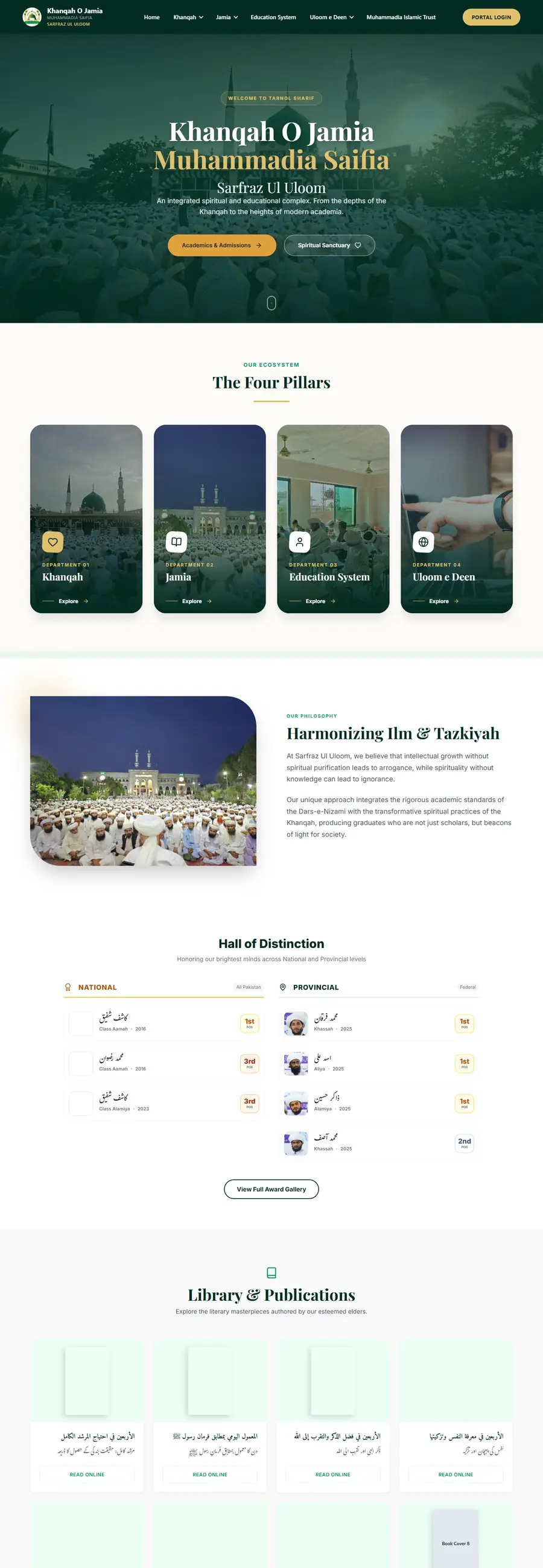
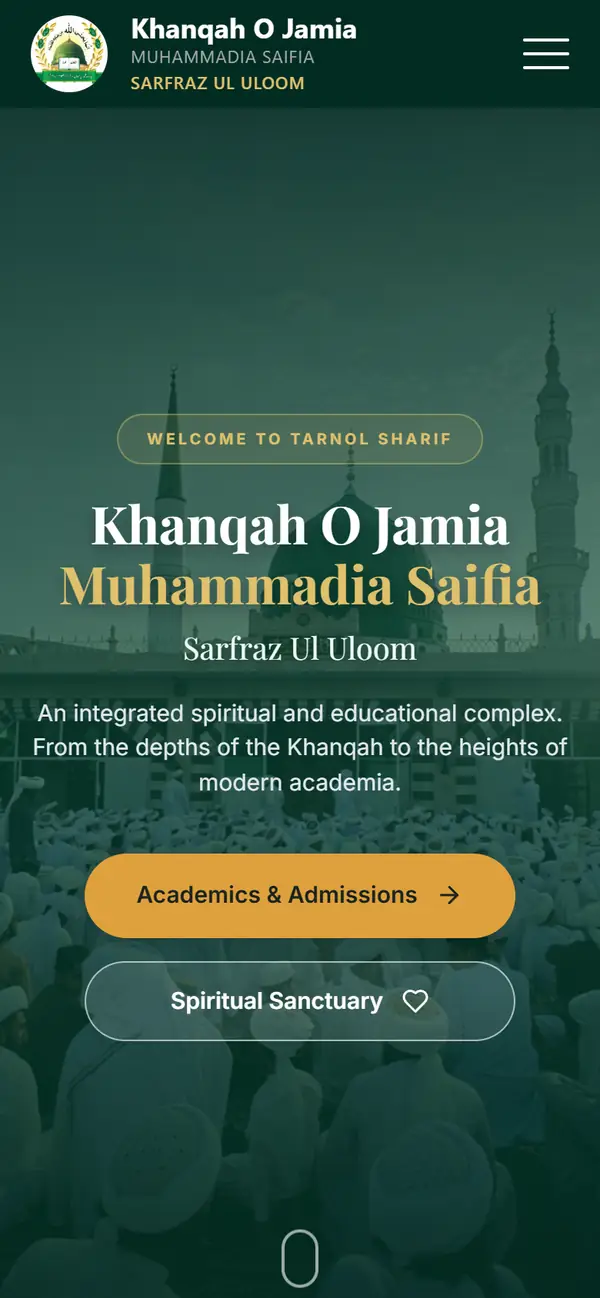
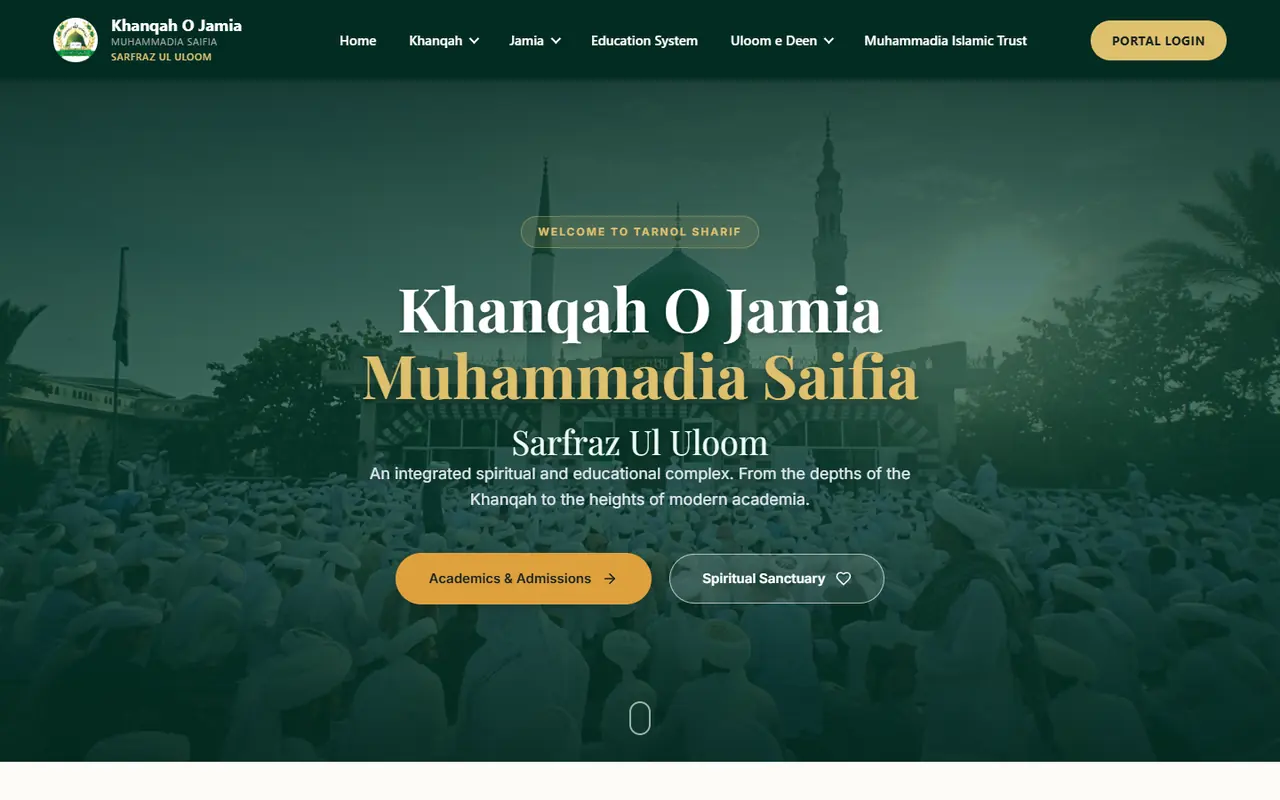
Hover the browser to scroll the homepage
Khanqah, Jamia, the Education System and the Uloom e Deen online academy, plus the Muhammadia Islamic Trust.
Library, Sunnahs, quizzes, courses, self-accounting, Quran and news.
As a 30-day cycle: six or seven a day, never all 193 at once.
The first, forty hadith on I'tikaf, is live. Seventeen more await scholarly review.
From 43:88 on, each one matched against the printed mushaf the institute reads from.
The Quran, the Sunnah programme and prayer times live inside the app, so they open instantly and cost nothing in data. No account is needed, worship is never ranked or scored, and location is never recorded.
01 · The website
Four departments,
one home.
The institute runs four departments under one roof, and the site gives each its own section in English, Urdu and Arabic:
- Khanqah: audio and video speeches (bayanat), a library of Saifi literature with online reading, and the Shajrah, the golden chain of transmission.
- Jamia (seminary): departments, admissions, faculty, events and national awards, and co-curricular activities.
- Education System: modern schooling on the ISMUBA model, integrating science with Islamic values.
- Uloom e Deen online academy: a course catalogue on the learning platform, plus a login to the student portal.
The latest speeches come straight from YouTube, and a Leaflet map shows the way to the institute.
- WordPress
- Elementor
- Urdu / Arabic RTL
- Book library
- LMS
- Student portal
02 · The app
Seven parts,
one app.
Library & audiobooks
The institute's books, readable in full, with narration that keeps playing with the screen locked, chapter navigation, adjustable text size and your place kept between sittings. Each work is listed once, with its cover, Arabic name and author.
Daily Sunnahs
The Khanqah's Dīn ka Ma'mūl, 193 practices, as a 30-day cycle of six or seven a day. Every reader gets their own thirty days from the day they begin, a checklist that starts fresh each morning, gentle reminders, and a way to catch up on missed Sunnahs.
Creed & quick quizzes
The institute's own questions on Aqā'id, Salah, Zakat and more, in short rounds that fit into a few spare minutes and resume where they stopped.
Learning Center
The institute's books turned into courses, read a section at a time, with a short check after each lesson where every answer is explained, flashcards that return just before you'd forget, and every point citing its book and page.
Self-accounting
Private daily rings for Sunnah, tilāwat, dhikr and any goal you add, the Nafi-o-Asbat sabak with its Laṭā'if map redrawn clearly, and all 36 Murāqaba intentions, each with its recording beside it.
Quran & tafsīr
The whole Quran inside the app with Kanzul Iman and English, word-by-word meaning, tafsīr on every verse and colour-coded tajweed, in Indo-Pak or Uthmani script. On the printed mushaf page, holding a verse selects it and the recitation turns the page.
News, media & prayer
Official announcements and events, speeches and naats, commemoration days, prayer times in your city's own clock, the Qibla, home-screen widgets, and an Islamic date that follows the institute's own announcement of each new month.
Admin & the office
A Flutter web panel where the institute's editors publish books, news and courses themselves, an About page the office keeps current, and a Report a problem button that reaches the office directly.
03 · What it changes
Everyday problems,
lasting answers.
| Feature | Everyday problem | Long-term benefit |
|---|---|---|
| Library & audiobooks | The books are at the Khanqah and you aren't, and there's no quiet hour to read. | A commute, a queue or a wait becomes study. |
| 30-day Sunnah cycle | 193 Sunnahs is too many to face, so the booklet is read once and shelved. | The whole Ma'mūl covered every month, as a habit that holds. |
| Creed quizzes | Beliefs learned years ago fade, and nothing tests whether they're still held. | Core creed kept present and correct, at any age. |
| Learning Center | A lecture heard once is mostly gone within the week. | Knowledge that lasts the year, traceable to the institute's own books. |
| Self-accounting | "How was my week?" is answered by memory, and memory flatters. | Honest daily muhāsabah, kept private. |
| Murāqaba & sabak | The sabak sits on a folded photocopy that's hard to read correctly. | The Khanqah's own method, practised accurately anywhere. |
| Quran & tafsīr | No data allowance, no mushaf to hand, nobody nearby to ask. | The Quran and its meaning always at hand, matching the institute's own mushaf. |
| Prayer times & Qibla | Times differ by city, and a traveller can't find the direction. | Prayer on time and rightly faced, anywhere. |
| News & media | Notices get lost in group chats, arriving late or not at all. | One authentic channel for the whole community. |
04 · August – October 2026
What changed
since August.
The Quran text, checked page by page
- Every correction verified against the printed Indo-Pak mushaf the institute reads from, never against another edition with different spelling and pause marks.
- The waqf lāzim restored at 43:88 and twenty-four more ayahs.
- Three words the qaris reported corrected, the dagger alef restored at 30:15 and 30:45, a shadda removed at 3:130 and the jazm restored at 5:29.
- A full comparison with an independent copy of the same edition found no further errors. Four reports that weren't faults were left alone rather than "fixed" into error.
- Tajweed colours now match the mushaf, with the same four rules in the same four colours, in both scripts.
The Learning Center, its own tab
- Opens where you left off, with lessons read a section at a time instead of one wall of text.
- Progress kept on the phone, with a backup the user owns. No account, nothing uploaded.
- The first course, forty hadith on I'tikaf, is published with all ten lessons.
- Courses from seventeen more of the institute's books are drafted and awaiting scholarly review, every citation checked against the books.
- Editors write, publish and revise courses themselves from the admin panel.
Urdu that reads like Urdu
- The app had been setting Urdu as if it were English. Nastaliq now sets only the Urdu, so dates, page numbers and prayer times come out cleanly.
- Line spacing is what the typeface asks for, so descenders and ﷺ no longer strike the lines around them.
- Page ranges like 33–35 no longer read backwards.
- Text is set by the script it's in, not the app's language, so English inside an Urdu screen reads correctly, and the reverse.
Smaller things that got in the way
- Each reader's own thirty days of the Ma'mūl, instead of starting a newcomer on someone else's day 1. Completed Sunnahs are highlighted, not struck through.
- Optional accounts with Google sign-in, plain messages in both languages, and no lost account if the connection drops at the wrong moment.
- Quran recitation and mushaf page images moved to the institute's own server.
- Murāqaba recordings now sit beside the intentions they belong to.
05 · How the content is handled
Where accuracy
matters most.
- Nothing machine-written gets published. Every lesson comes from a book the institute wrote, cites its page, and waits for a scholar's review before anyone sees it.
- Nothing added. No ruling, virtue or narration the book doesn't state, and no reference the book leaves out. Where a book is unclear, it becomes a question for the scholars, not a guess.
- The Quran is corrected only against the printed mushaf, after checking how the text spells the same word elsewhere. A reported fault that isn't one is left alone. The few marks still open are changed only once they've been read off the printed page.
- Private by design: worship is never ranked or scored, location is never recorded, and progress stays on the phone with a backup the user owns.
- Self-hosted media: Quran recitation, mushaf page images and book PDFs are served from the institute's own server, with books behind token-checked access.
- Flutter
- Dart
- Firebase Auth
- Firestore
- Cloud Messaging
- Flutter Web admin
- Offline-first
- English / Urdu
06 · Why it matters
Distance stops
mattering.
Until now, how close someone was to the Khanqah depended on where they lived. The website gives every department a public home, and the app puts the Quran, the books, the daily Sunnahs and the institute's own courses in the hands of anyone, anywhere. What the Khanqah has always given to those who could reach it, it can now give to those who can't.
The app is still in development. This page grows as new features ship.
to 390K →